
A Camino less traveled
-
 January 5, 2026
Pilgrimage is an ancient tradition that is becoming popular again. The premier walking pilgrimage is the one to Santiago de Compostela in Spain, known simply as “the Camino.” Hundreds of thousands of people now walk the Camino every year—so many that it has become crowded. Having walked it twice I can highly recommend it, but there are alternatives. Many communities are now putting into place or restoring pilgrimage routes.
Last summer I walked one of these new caminos. I went to Orkney, an island in northern Scotland, and walked the St. Magnus Way. Never heard of St. Magnus? Most people haven’t. He is a Scandinavian saint who was martyred when Orkney belonged to Norway. He was the Earl of Orkney back in the 12th century. There was a dispute with his cousin Hakon and they held a meeting to resolve it. However, Hakon arrived with a fleet of armed ships and had one of his men murder St. Magnus. St. Magnus died in prayer, forgiving his cousin and murderer. His last words were, “take heart, poor fellow, I have prayed that God grant you his mercy.” Later miracles were attributed to St. Magnus’ relics and devotion to him grew.
The pilgrimage route stops at various places associated with St. Magnus. You can walk or bike the route, which is about 58 miles long. Compared to the Camino in Spain it is not crowded at all. Solitude is a good thing on a pilgrimage. However, everyone I met was friendly and delighted I was making the pilgrimage. I began by praying at the Church of Our Lady and St. Joseph in Kirkwall, asking their intercession for my trek.
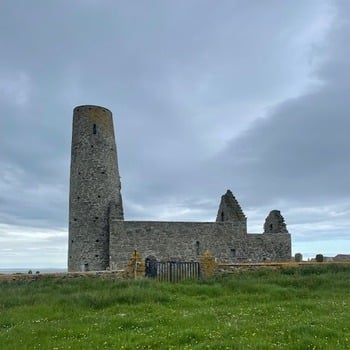
The route’s first day is on the island of Egilsay. The walk across the island is three miles round-trip. You pass by the earliest church of St. Magnus, the place where he was murdered, and the beach where the ships landed. I found time to pray in the ruins of the church and enjoyed seeing one of the smaller islands.
The second day takes you up the coast. The day I walked, there were gale force winds and driving rain off the sea. My host said it was the worst weather he had ever dropped anyone off in. It’s all part of a pilgrimage! You learn you are not in control and that suffering is also part of your journey. A storm shows you the beauty and vastness of God’s creation. I kept thinking of Jesus stilling the waters.
The third day I continued up the coast and the weather became wonderful, with fantastic views over the sea and the island. Birds and wildlife were plentiful. Pilgrimages have their good days where everything goes right. This day was peaceful and a time to find joy in God’s creative work. This section ends at St. Magnus Church in Birsay.
The next day I biked, as I was behind schedule. The bike path followed most of the walking route. I passed by St. Magnus’ Well, St. Michael’s Kirk, Binscarth Wood, Ophir Kirk, and ended at the Round Kirk. The Round Kirk, dedicated to St. Nicholas, is the only surviving round church in Scotland and dates to the late 11th century. It was built in imitation of the Holy Sepulcher in Jerusalem. Hakon made a pilgrimage there after murdering St. Magnus, no doubt to do penance. Crusaders brought back the tradition of round churches to Europe. It was a great place to pray and mediate on how for nearly a thousand years Christians worshiped here.
The final day I walked into Kirkwall, the capital of Orkney. The pilgrimage route ends at the magnificent St. Magnus Cathedral, called the Light of the North. It was built in 1137 by St. Rognvald, a cousin of St. Magnus. A pillar there has the relics of St. Magnus, marked with a brass plaque. It is full of history, fascinating carvings, and art. In 1560 after the Scottish Reformation it was converted for Protestant worship. Currently it has a Church of Scotland congregation, but other churches can use it. It is a fitting end to the pilgrimage. The building’s light and dark contrasts are conducive to prayer. I prayed for all the intentions I took with me and asked St. Magnus to intercede for them. There is also a pilgrims table where you can sign a book. Every pilgrim who finishes the pilgrimage receives a certificate and shell, a traditional sign of pilgrimage. The Bishop of Aberdeen generously granted me an indulgence for making the pilgrimage.
Walking one of the lesser-known pilgrimages is a wonderful way to experience spiritual renewal in a less hectic way. St. Magnus may not be well known, but in heaven, all the saints pray for us. I ended my trip with a visit to the Italian chapel, built by Italian prisoners of war in WWII. It is two huts joined together, but the art and decoration is really stunning. It is a symbol of peace and reconciliation. Orkney is a beautiful place, the scenery is breathtaking, and there are many other things to see.
If you want to take a camino that is less traveled, grow in prayer, and gain a sense of peace you can’t do much better than the St. Magnus Way.