
A tour of the Basilica of St. Mary Major, where Pope Francis is buried
-
 June 4, 2025
The Basilica of St. Mary Major in Rome is the oldest church dedicated to Our Lady. It dates back to 422 and is one of the four major basilicas in Rome. This basilica comes with a legend; a Roman patrician and his wife owned the land but had no heirs. The wife prayed to the Virgin Mary asking how to dispose of the property in her honor. On Aug. 5, at the height of the Roman summer, snow fell on the site during the night. At the same time, the pope had a dream of the forthcoming summer snowfall and he went in procession to the spot to mark the area in which the church would be built in honor of the Mother of God. Therefore, another title of Our Lady is “Mary of the Snows.” This church in years past has also been called “St. Mary of the Crib” because it holds the precious relics of four boards of sycamore wood believed to be part of the manger that held Jesus at the Nativity.
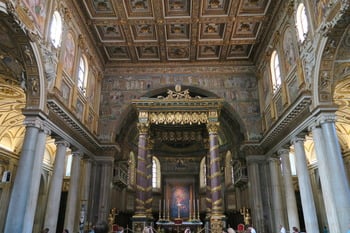
The architecture of this church is Roman basilica style complete with a triumphal arch above the sanctuary. Roman arches were originally built outside as stand-alone structures to mark victories of the emperors in battles. The emperors would return from battles bringing back the spoils of war through their cities in triumph, thus the name for these arches. The arch pictured here is under the sanctuary, the procession of triumph over sin and death, to the altar of sacrifice and the victory of salvation.
The mosaics on the arch are the oldest in the church and date from the 5th century. They depict the story of Jesus and celebrate the affirmation of Mary as Theotokos (Mother of God). One of the first scenes is a panel of Christ's enthronement with a group of angels as his court. He is dressed like a Roman emperor and angels are dressed like Roman senators. Not knowing how to depict Jesus Christ, artists chose to dress him in the royal garb of the time. The mosaics depict God’s revelation to his people through Jesus, son of Mary. The story of Christ’s childhood is not told chronologically across the arch but rather with scenes that demonstrate the divinity of the Child and the dawn of the era of salvation for the whole world. In the image shown in the lower section, the Child presides from a jeweled throne as the Magi arrive to give him homage. There are two images of Mary on each side of Christ. The one on his right shows her as his earthly mother who gave him flesh and on the other side, she is dressed in gold as Mother of the Church, the eternal Mother. The mosaics of the triumphal arch and the nave gave a model for future representations of Jesus and the Virgin Mary.
A famous Marian icon, called Salus Populi Romani (protector of the Roman people), is enshrined in a side chapel at St. Mary Major. This icon, which traces back to 590, was a favorite of Pope Francis. He would stop here to pray before the icon before he left town. The image was brought to St. Peter’s Square and placed beside the altar on the day of Pope Francis funeral. Pope Franics requested to be buried in this church not far from the chapel where the icon is located.