
Crossing the Tiber River – the Bridge of the Angels
-
 November 24, 2025
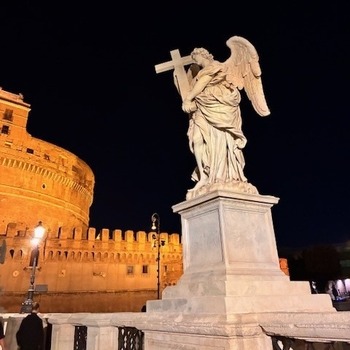
The last stop on our pilgrimage to Rome is the Ponte Sant’ Angelo Bridge, the Angels Bridge. This is not just an ordinary bridge, but in times past it was the only bridge across the Tiber River by which pilgrims would reach their destination of St. Peter’s Basilica.
The bridge was constructed in 134 AD by the Roman Emperor Hadrian. It was used to reach his newly constructed mausoleum. The mausoleum was later turned into a papal fortress during the Early Middle Ages. Its name changed to Castle San Angelo due to an appearance of St. Michael the Archangel during the plague in the 6th Century. It was Pope Gregory I who made a procession through Rome to pray for the end of the plague. As he approached the castle, he recounts a vision in which he saw the angel sheath a bloody sword, which he took as a sign that the plague that had been ravaging Rome for years was finally over. A sculpture of St. Michael was placed on top of the castle as a constant reminder of God’s mercy through the intercession of the Archangel.
In the Jubilee year of 1450 the number of pilgrims crossing the bridge became too much and the railings on the side collapsed. An estimated 200 people fell and drowned in the river. In response to the tragedy, the pope ordered two chapels to be placed at the end of the bridge so that Masses would be offered for those who died. In 1535 the chapels were torn down, and statues of St. Peter and St. Paul were set in place.
Through the years, various sculptures were placed on the bridge, including the evangelists, patriarchs, and angels. However, they were not made of the sturdiest material and eventually fell into ruin. In 1669, Pope Clemente IX commissioned one of the greatest sculptors in all of Europe, Gian Lorenzo Bernini, to sculpt ten angels with each one holding an instrument of the passion. Pope Clement IX wanted the approach from central Rome towards the Basilica of St. Peter to be a spiritual path for pilgrims to reflect on the passion of Christ. The angels tell the story of the Passion chronologically, beginning at the righthand side of the southern end of the bridge. The Latin inscription below each angel describes that moment in the Passion. For example, the inscription below the first angel who holds a piece of the column that Christ was scourged upon reads, TRONUS MEUS IN COLONNA, My throne is upon the column. It continues as such:
IN FLAGELLA PARATUS SUM (I am prepared for the scourge)
IN AERUMNA MEA DUM CONFIGITUR SPINA (In my pain, the thorn is fastened upon me)
RESPICE FACIEM CHRISTI TUI (Look at the face of your Christ)
SUPER VESTIMENTUM MEUM MISERUNT SORTEM (For my clothing, they cast lots) (Ps 22)
ASPICIENT AD ME QUEM CONFIXERUNT (They will look at me, whom they have pierced) (Zach 12:10)
CUIUS PRINCIPATUS SUPER HUMERUM EIUS (Dominion rests on his shoulders) (Isa 9:6)
REGNAVIT A LIGNO DEUS (God reigned from the tree) (Ps 96:10)
POTAVERUNT ME ACETO (They gave me vinegar to drink)
VULNERASTI COR MEUM (You have pierced my heart)
In the end, Bernini, actually only completed two of the angels himself and left the rest to his assistants. All the angels are still there today. The two angels he carved were moved to the church of Sant’Andrea delle Fratte in Rome and copies were made to replace them on the bridge.
The next time you are in Rome be sure to gaze upon the angels as you cross the Tiber River. The angels are more than just beautiful artwork but a powerful reminder for all Christians that their path in this life is toward the Eternal City of God. It is only by Christ’s passion and his way of the cross that we have access. This too becomes our path. Jesus assured his followers that “unless you take up your cross and follow me, you cannot be my disciples.” However, Christ shares the burden with us and becomes our strength and pilgrim guide along the way.