
Shanley High students featured in film about future saint talk tech, prayer, finding peace
-
 June 4, 2025
The sun was shining brightly May 6 as yellow school buses pulled up to West Acres Cinema. Fargo Shanley High School students in khaki shorts, plaid skirts, and red sweaters filed off one by one.
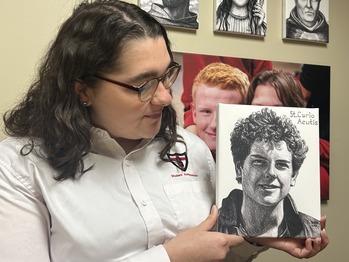
But this wasn’t a typical field trip. They weren’t there to catch the latest superhero flick or even the new Minecraft movie. They came to see themselves on the big screen—along with a teenage boy in sneakers soon to be a saint. The film, Carlo Acutis: Roadmap to Reality, is a documentary chronicling the life of Blessed Carlo Acutis, the first millennial on the path to sainthood. It also features 151 Catholic high schoolers and chaperones from North Dakota—including a group from Shanley—who traveled on a pilgrimage to Italy last summer, including a stop at Acutis’ final resting place.
Born in 1991 to a wealthy Italian family, Acutis isn’t what many picture when they think of a saint. He’s deeply relatable to Gen Z. He wore sneakers and jeans, played sports and watched American sitcoms.
“He literally had a PlayStation just like us. That’s pretty crazy to think about,” said Emily Gietzen, a Shanley senior who went on the trip and is featured prominently in the documentary. So what put this seemingly regular kid on the path to sainthood?
He took the burgeoning internet and turned it into a tool to spread the word of Jesus Christ. He utilized his technical skills to create a website cataloging Eucharistic miracles and share his love for the faith online. Millions of people, including young followers, began paying attention.
Pope Francis called him an “Influencer of God,” but according to the film, Acutis didn’t aim to be famous. His goal was to use the internet to bring people back to church—and to Christ.
And he lived it. While he inhabited the same digital world as teens today, he limited his PlayStation time to just one hour a week, making space for daily Mass, time outdoors, and being with loved ones. Sadly, Acutis died at age 15 after a short battle with leukemia.
But his mission of using technology in a thoughtful and faith-focused way stuck. The North Dakota students on the pilgrimage spent two weeks in Rome without cell phones—something that seemed nearly impossible for a generation that spends six to seven hours online every day.
“We were kind of freaking out at first about not having our phones,” Gietzen admitted. “I thought I was going to miss out on everything. But honestly, it was the most free I’ve felt in a long time. We read books, played cards on the plane; it felt like a reset.”
But for Gietzen, the trip, which was organized through the University of Mary in Bismarck, was more than a tech detox. It became a spiritual awakening, shaped by personal pain and unexpected peace. Just weeks before the trip, Gietzen’s mom, a single parent and constant presence in her life, was diagnosed with a brain tumor. Doctors wouldn’t be able to confirm if it was cancerous until after Emily returned. That uncertainty weighed heavily.
“I remember being so angry at God,” she said. “I was like, ‘Why her?’ She’s the one person who’s always been there. I didn’t understand.”
That anger came to a head in Assisi, at Acutis’ tomb.
“Standing in front of it, I just started bawling,” she recalled. “I prayed, ‘Please help my mom. And help me get closer to God.’ It felt like a full-circle moment.”
In that quiet church, away from cell signals and distractions, something shifted.
“I went back to my pew, still mad at God, but I kept praying. And I felt this calm—like a hug, honestly. I remember feeling Him say, ‘It’s OK to be mad. I still have a plan,’” she said.
When she returned home, doctors confirmed the tumor was not cancerous. It couldn’t be removed due to its location, but it wasn’t growing.
“That was a blessing in itself,” Emily said. “It’s not perfect, but it’s OK. And I have peace about it now.”The film highlights moments like these—raw, real and faith-filled—as teenagers reflect on what it means to be young Catholics in a digital world. It shows how their faith became more personal, less performative.
“I used to feel jealous of people who had big conversion stories,” Gietzen said. “But after Rome, I realized I kind of had one too. It brought me closer to God. I’m definitely deeper in my faith now.”
Shanley Principal Father Kyle Metzger believes the phone-free environment played a big role in opening students up to those experiences.
“A kind of spark happened after the two weeks,” he said. “By the end, students started intermingling with kids from the other schools (including Minot’s Bishop Ryan, Bismarck St. Mary’s, and Dickinson Trinity). They built friendships, and now they know those kids. We don’t think that would’ve happened as readily if they had their phones.”
The release of the film comes at a poignant time for the Catholic Church. Acutis was scheduled for canonization on Apr. 27, but it has been postponed following the death of Pope Francis on Apr. 21. His canonization could now be one of the first official acts of the new pope Leo XIV. The Pope’s death also reshaped a red-carpet premiere for the film in Washington D.C., held less than 24 hours later. The event, which Gietzen and classmate David Hollcraft attended, was almost canceled, but instead was scaled down out of respect.
Back in Fargo a week later, students filled two theaters watching the film. Some girls snuggled under blankets brought from home, while some boys got a kick out of watching the halls of their high school splashed across the big screen.
While Emily joked about being nervous for her peers to hear her interviews in the film, the deeper message stayed with her: about faith, about hope and about the future of her generation.
“Carlo evangelized through social media,” Gietzen said. “And I think that’s the coolest thing ever. We, as young people, can really try to connect with that and use technology for good, instead of letting it use us.”