
Search
The Basilica of St. Augustine in Rome
-
 October 23, 2025The Basilica of St. Augustine in Rome is the motherhouse of the Augustinian friars, the same order that Pope Leo XIV belongs to, and a gem not to be missed when in Rome. The first church built here was commissioned by Pope Boniface VIII, the pope that began the first Jubilee Year 1300. The building material for the façade was salvaged from the ruins of the Colosseum, which at that time was a quarry.
This church is full of “mother” themes. The most famous saint buried in this church is not St. Augustine of Hippo as one might think (he is buried in northern Italy), but rather his mother St. Monica. St. Monica was known for praying fervently for her wayward husband and now well-known son who wrote about his mother in his famous work, Confessions.
Down the main aisle of this church is a beautiful sculpture of St. Anne with the Virgin and Child Jesus. If you look up past the sculpture, you will see a fresco of the Prophet Isaiah, by the famous painter Raphael. Isaiah holds a scroll that says, “Open the doors, so that the people who believe may enter” (Isa. 26:2-3). The Virgin Mother is known as the door to heaven. The cardinal who commissioned the work had a great devotion to St. Anne and the Virgin Mother.
Located to the left of the front door is a monument created in 1521 which is dedicated to mothers called the Madonna of Childbirth. People stop here and pray for our Mother’s intercession for safe deliveries and for good health of babies. You can see all the pink and blue ex votos (flowers and tokens) left there in thanksgiving for answered prayers.
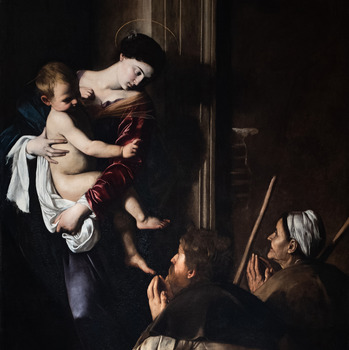
As the pilgrim passes that sculpture, the next mother theme image to see is the painting by Caravaggio titled The Madonna of Loreto, 1604. This is a rather evocative painting for that era. The painting depicts the Virgin Mother holding the Child Jesus in her arms as she stands barefoot in the doorway to her house. Two poorly dressed and tired looking pilgrims kneel before her. The scene is a moment where ordinary people, if not a bit rough around the edges, encounter the divine, whose appearance is equally ordinary.
This church was on the medieval pilgrim route. It was one of the stopping points for pilgrims before they crossed the Tiber River to get to their destination, St. Peter’s Basilica. By the time they got to Rome, many of these pilgrims were battered after walking for weeks or months to get to Rome, so it is probably an accurate depiction of medieval pilgrims. However, the rather grubby appearance of the two pilgrims in the painting offended many sensibilities of the time. Back in this time, one didn’t put images of poor, dirty people in churches, especially showing the bottom of their dirty feet, which represented sin. The other controversy was that the model Caravaggio used for Our Lady was a well-known courtesan in town. Ironically, this church was known to welcome certain courtesans with well-known connections. They were even given places of privilege for burial in decorative chapels. You won’t see these chapels today, as when renovations were made the ladies’ remains were reburied at different locations.
This church is not as crowded with pilgrims as some of the other famous churches in town, but is a highly recommended stopping point, especially for mothers and those who want to offer a special prayer for mothers.